
-
- Call us anytime
1-800-820-9971
- Email us now
contact@ecoroads.com




FAQ
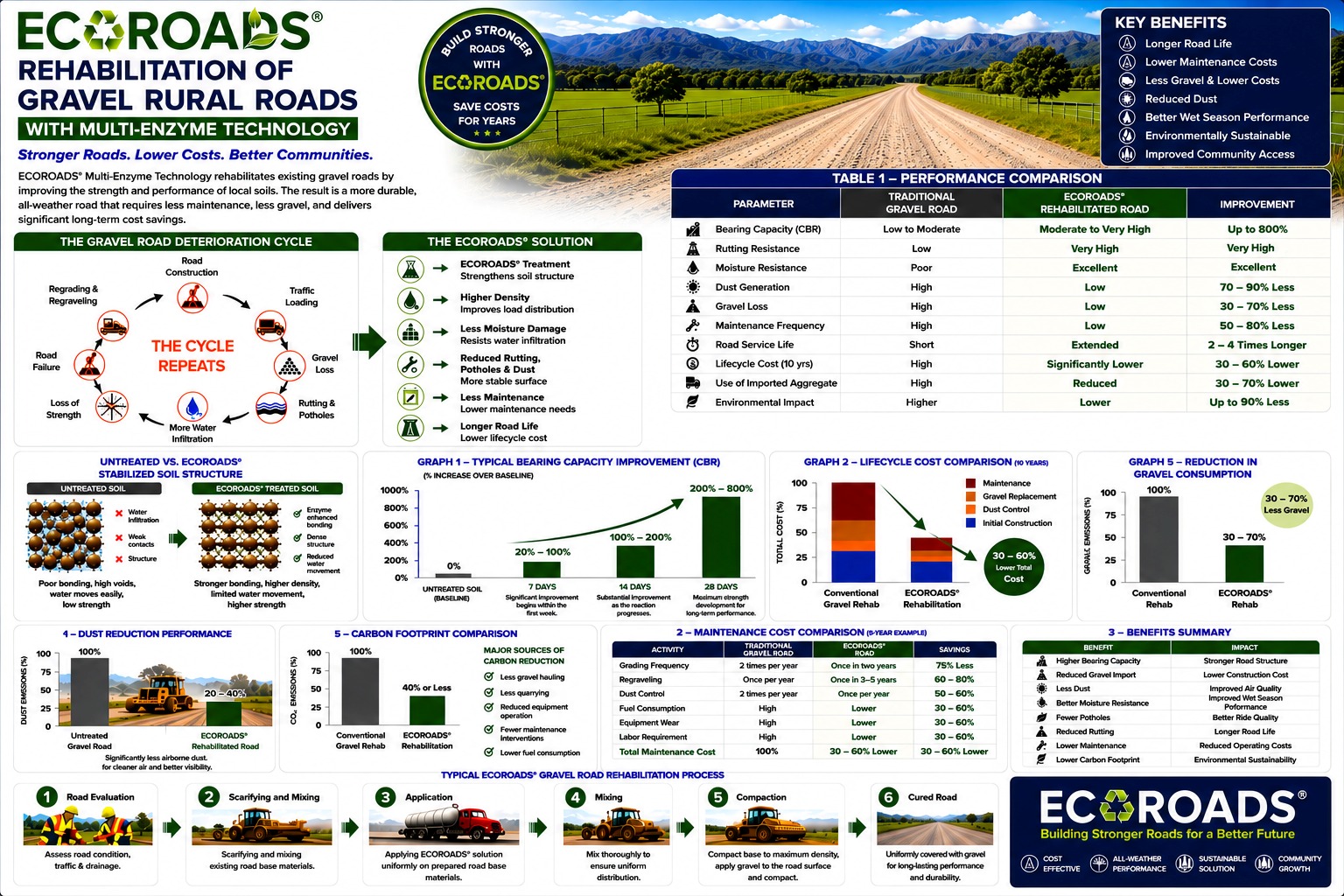
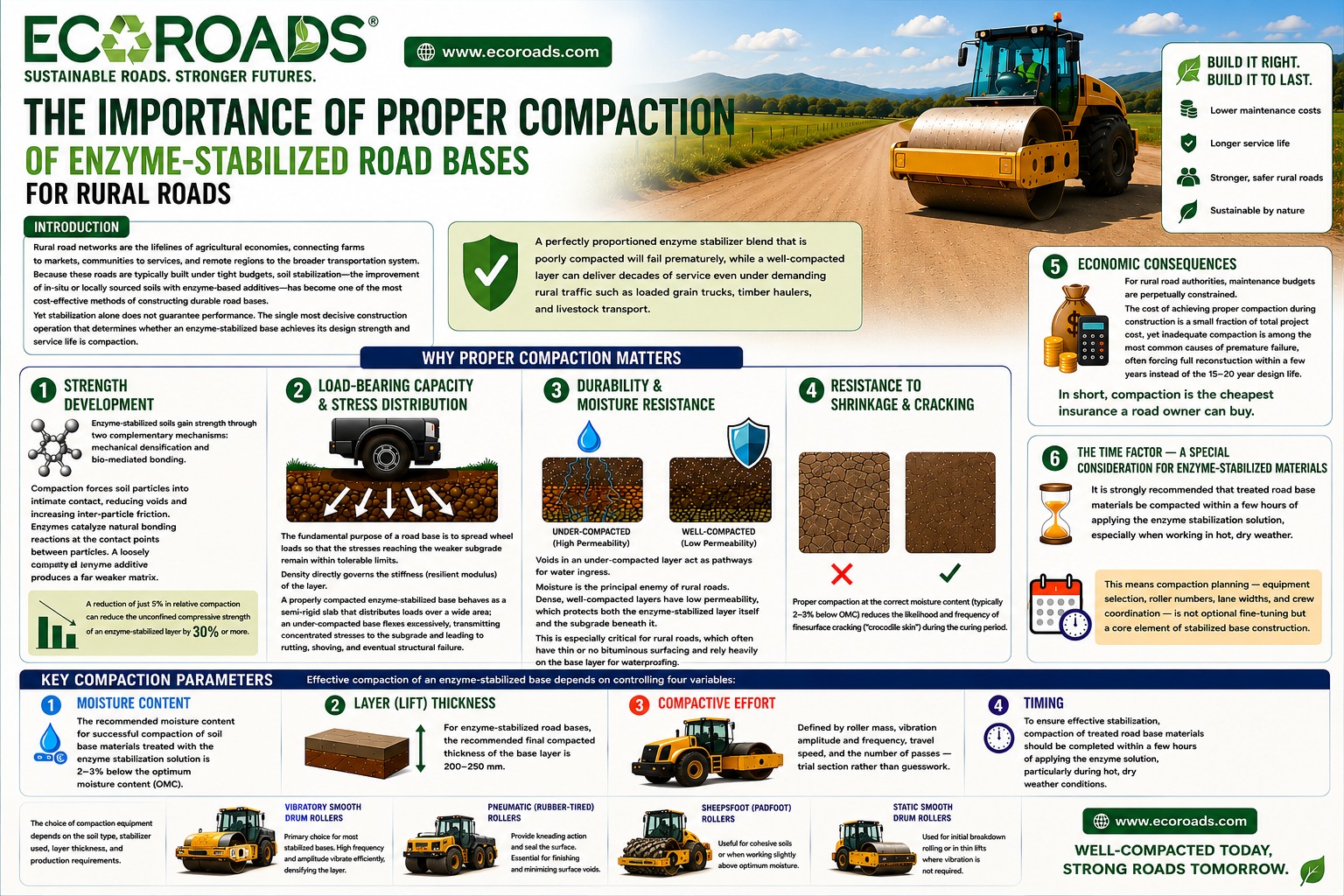
Enzymes increase the compressive strength of soil. The enzyme acts as a catalyst to accelerate and strengthen road material bonding, creating a dense, more cohesive and stable soil. Enzymes also reduce the compaction effort and improve soil workability while lubricating the soil particles. This makes the soil easier to grade and allows the compactor to achieve targeted soil density with fewer passes.
Enzyme stabilization also:
• Increases soil density: helps reduce voids between soil particles by altering electro-chemical attraction in soil particles and releasing bound water. The result is a tighter, dryer, denser road foundation
• Lowers water permeability: Tighter soil configurations discourage the migration of water that normally occurs in the voids between particles. Greater resistance to water penetration deterioration.
• Is environmentally safe: Enzymes are natural, safe (organic) materials. These materials are non-toxic and will cause no harm or danger to humans, animals, fish or vegetation.
After compaction, the expansion-contraction ratio will be dependent upon the soil type (percentage of expansive clays) as well as the gradation range (distribution of particle sizes). Well-graded soil (ranging from -200 mesh to 1 inch) is ideal for road building. The -200 mesh fines should be approximately 20%. If the frost level extends below the level of the road, some heaving may occur. However, in the spring the road should settle back to is original elevation without severe damage. Proper road construction including shoulder drainage will minimize the effects of frost. Good engineering practices should be observed. Hot weather should not affect a road, other than dry dirt surfaces tend to be dusty under high wheel loading. ECOROADS® treated surfaces will reduce the amount of dust.
Road constructed with soil mix containing a high clay contact will exhibit slippery surfaces when wet. It is necessary to use as much aggregate as possible to increase overall strength of the road and increase traction in wet conditions. In many applications, surface treatment is applied as part of the overall design. This provides a wearing surface for traction, moisture protection, and greater overall strength. Cost and availability of materials are the primary factors affecting the type of surface treatment. ECOROADS® is used to stabilize the road and a thin "chip seal" is placed over the surface, the road can last several years without any significant maintenance.
ECOROADS® treated soils achieve their greatest strength during the 3-4 months
period after compaction. Bonding of the soil particles takes place in the presence
of moisture and compactive force. This condition will last as long as the material
resists external forces. Heavy wheel loads, water, freeze-thaw cycles ultimately
have an effect on all roads. ECOROADS® treated soils resists these forces due
to the bonded, high density of the road material. The road will resist the
detrimental effects of erosion and mechanical forces.
Note that when the clay fines (minus 200 mesh) exceed 25% or are highly expansive,
some surface cracking will occur. Generally the cracks are superficial, often
filling in with road particles during normal traffic use. This condition is often
referred to as “Alligator Cracking” and does not significantly affect the stability
of the road base. Rain or other moisture will moderately swell the clay fines and
the cracks will close. If the clay material is highly expansive, then the amount of
fines should be kept low to reduce the amount of cracking.
Prior to placement of any surface material, ECOROADS® treated soil should be
lightly sprayed with a dilute solution of water and ECOROADS® to assist in
the bonding of the new surface material (i.e. asphalt) to the road base. Moisture
will close many of the cracks.
ECOROADS® sells in 5 gallon plastic pails or 55 gallon plastic drums. Delivery must be carried out in conditions that the temperature of the delivery environment does not fall below +5 ° Celsius and does not rise above +40° Celsius, and ECOROADS® can not be exposed to direct sun or any external variables, including chemical, biological or other external influences. ECOROADS® must be stored between +5° and +40° Celsius and kept in properly ventilated storage area, away from any external chemical or biological influences, or in direct sunlight.
 Optimized by Seraphinite Accelerator