


Introduction
Across the world, an estimated 3.4 million kilometers of rural roads remain unpaved. These roads form the backbone of rural economies, connecting farms to markets, villages to schools, mines to processing facilities, and communities to healthcare services. In many developing and remote regions, they are the most critical transportation infrastructure available — yet they are also among the most costly and difficult to maintain.
The economic stakes are enormous. According to the World Bank, poor rural road conditions can reduce agricultural income by 20–30%, increase transport costs by up to 40%, and limit access to education and healthcare for hundreds of millions of people. For road authorities and infrastructure managers working under tight budgets, the challenge is not simply building roads — it is keeping them functional year-round with finite resources.
Every year, road authorities spend substantial sums on grading, gravel replacement, pothole repair, and dust suppression. Yet despite this expenditure, the same problems keep returning. Roads that are shaped in one season develop ruts and potholes in the next. Gravel that is imported at great expense gradually disappears into dust or migrates to the shoulders. Maintenance crews are perpetually reactive rather than proactive.
The reason for this failure cycle is not a lack of effort or resources — it is a fundamental misdiagnosis of the problem. Most gravel road failures originate beneath the surface, in the road base level structure.
While conventional maintenance programs focus on surface treatments, the real issue is often the weak, moisture-sensitive base and sub-base layer that underpin the road. When these layers cannot adequately support traffic loads, surface improvements — no matter how frequently applied — provide only temporary relief.
Why Gravel Roads Fail
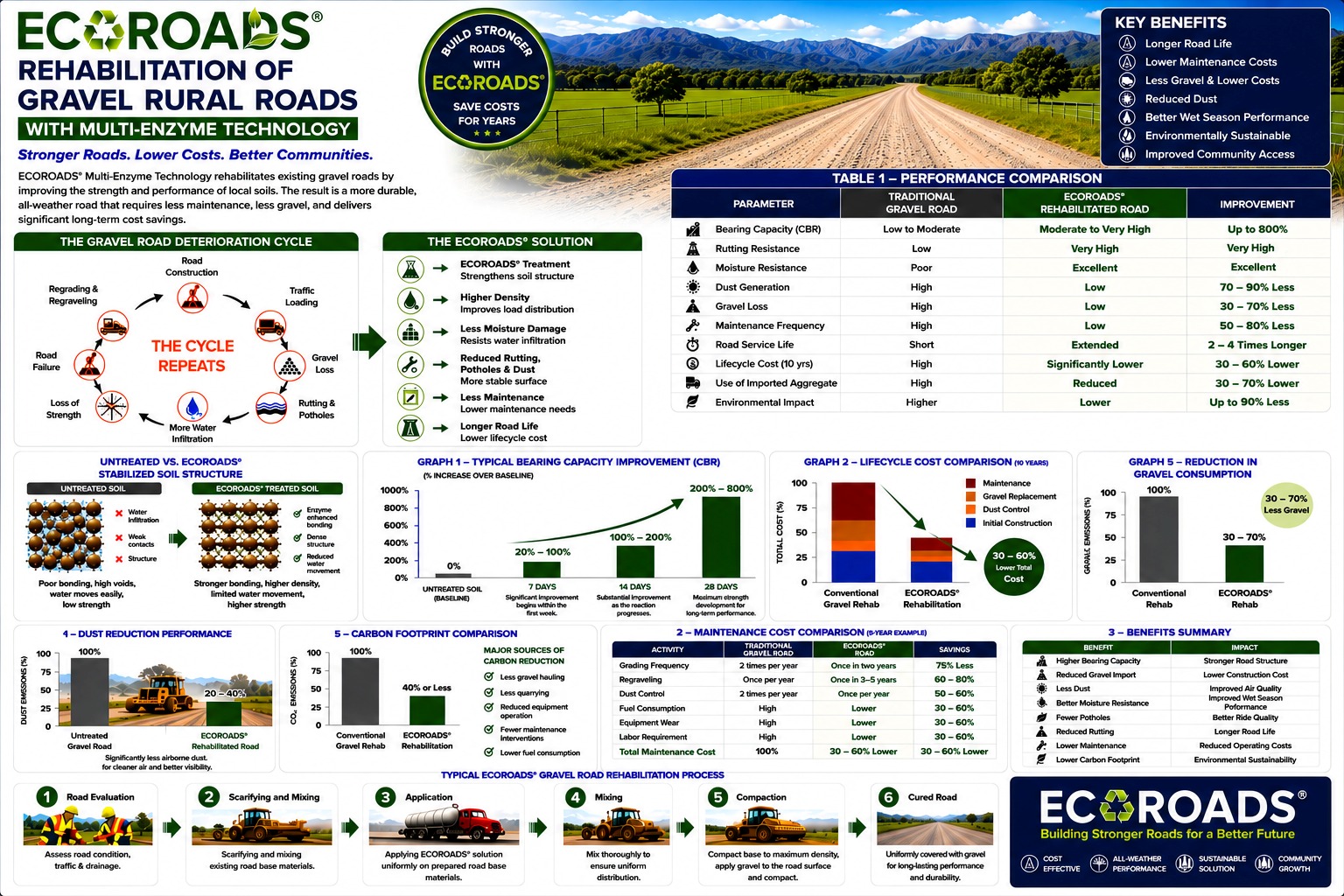
A clear understanding of why gravel roads fail is essential for selecting the right solution. Road deterioration is rarely the result of a single factor. Instead, it is typically the outcome of multiple interacting forces — water infiltration, weak road base materials, traffic loads, and gravel loss — that together create a self-reinforcing cycle of degradation.
Water: The Primary Driver of Deterioration
Moisture is responsible for the vast majority of gravel road failures worldwide. When water infiltrates the road structure — through rainfall, surface runoff, rising groundwater, or snowmelt — it triggers a chain reaction of engineering problems that compound over time.
The process begins at the base and sub-base materials level. Base and sub-base materials absorb water and swell, causing the structure to lose a significant portion of its shear strength. Under the repeated dynamic loads of vehicle traffic, this weakened materials deforms. Ruts form in wheel tracks, and as rutting deepens, water begins to pool on the surface, accelerating further deterioration.
This creates a classic deterioration spiral: water weakens the base materials, weakened road base layer deforms under traffic, deformation creates ruts, ruts collect water, collected water further weakens the soil. Without intervention at the structural level, this cycle is essentially self-perpetuating.
Seasonal fluctuations amplify the problem. Roads that perform adequately during dry months frequently become impassable during rainy seasons, isolating communities and halting economic activity at precisely the times when reliable access is most needed.
Weak and Moisture-Sensitive Subgrade Materials
Many rural roads are built using locally available soils because importing high-quality aggregates or crushed stone is prohibitively expensive. In most of the African countries, Southeast Asia, and Latin America, typical road-building materials include residual tropical soils, clay-rich alluvial deposits, and expansive silty clay soils — all of which present significant engineering challenges.
These materials commonly exhibit:
- High clay content leading to excessive plasticity and moisture sensitivity
- Plasticity Index (PI) values above 20, making them prone to swelling, softening, and deformation
- Poor drainage characteristics, causing water to be retained within the road structure for extended periods
- Low dry density and inadequate compaction response, resulting in weak structural layers
- High liquid limits, indicating a propensity to transition rapidly between solid and plastic states with small changes in moisture content
While these soils may initially appear serviceable, they typically lack the engineering properties necessary to withstand sustained traffic loading and environmental exposure. Without stabilization, roads built on these materials require frequent and expensive maintenance to remain passable.
Gravel Loss and the Hidden Cost of Re-Graveling
One of the most significant but often underappreciated costs of maintaining gravel roads is the continuous loss of aggregate. Under vehicle traffic, gravel is subjected to multiple destructive forces simultaneously: the vertical load of passing vehicles compresses and abrades the surface, while tire action causes lateral displacement of particles toward the road edges and shoulders.
Wind and water erosion further accelerate material loss, particularly during dry seasons when fine particles become airborne or during rainstorms when surface runoff carries aggregate off the road. On a moderately trafficked rural road, annual gravel loss rates of 25–50 mm of surface depth are common — equivalent to hundreds of tons of material per kilometer per year.
In remote regions where gravel must be transported significant distances — sometimes 100 km or more — the cost of sourcing, hauling, and placing replacement aggregate can reach $30,000 to $100,000 or more per kilometer over a 10-year maintenance cycle. These are recurring costs that offer no long-term structural improvement; they simply restore the road to a condition that will deteriorate again through the same processes.
Key insight: The fundamental problem with conventional gravel road maintenance is not that road authorities are doing the wrong things — it is that they are solving the wrong problem. Treating the surface while the road base remains weak is like repeatedly painting over a cracking wall without repairing the foundation.
Traffic Loading and Structural Fatigue
As rural economies develop, traffic volumes and vehicle weights tend to increase. Agricultural roads that were originally designed for light farm vehicles may eventually carry heavy trucks, combines, or logging equipment. Mining access roads face particularly severe loading conditions from haul trucks and heavy machinery.
Non-stabilized road base structures are poorly equipped to handle this increasing demand. Each overloaded vehicle passage creates micro-deformations that accumulate over time. What begins as slight surface roughness gradually progresses to visible rutting, then to pothole formation, and eventually to complete structural failure requiring full reconstruction — at costs orders of magnitude higher than preventive stabilization would have required.
Solution
The challenge of maintaining rural gravel roads is not a new one, and road authorities worldwide have wrestled with it for decades. Conventional approaches — importing more gravel, grading more frequently, applying surface palliatives — provide temporary relief at persistent cost. They address the symptoms of road deterioration while leaving its root causes untreated.
TerraFusion International, Inc represents soil stabilization/road construction product ECOROADS a solution from this reactive maintenance paradigm. By addressing the fundamental weakness of the road’s soil structure, ECOROADS transforms a cycle of deterioration and expense into a stable, long-performing infrastructure asset. The benefits are interconnected and mutually reinforcing: stronger soils require less gravel, resist moisture better, generate less dust, and need less maintenance — delivering a cumulative improvement in performance and cost-efficiency that conventional approaches cannot match.
The evidence from deployed projects with use of the ECOROADS product across diverse geographies and soil conditions is consistent: stabilized roads outperform untreated roads on every key metric — bearing capacity, moisture resistance, gravel retention, dust generation, and life-cycle cost — while also delivering significant environmental and social benefits.
For municipalities managing stretched maintenance budgets, for remote rural territories, for agricultural development programs seeking to improve market access, for mining and forestry operators requiring reliable access in remote areas, and for development agencies investing in rural infrastructure, ECOROADS offers a practical, proven, and cost-effective solution.
The goal of rural road management is not simply to maintain roads — it is to create and sustain transportation access that enables communities, economies, and people to thrive. Use of ECOROADS product helps make that possible.
By investing in the strength of the road structure itself, rather than repeatedly treating its surface, road authorities can break the cycle of continuous expenditure and declining performance — replacing it with a model of planned investment, extended service life, and sustainable infrastructure that delivers value for years and decades to come.
The ECOROADS Solution: Multi-Enzyme Soil Stabilization
ECOROADS offers a fundamentally different approach. Rather than continuously replacing surface materials, ECOROADS strengthens the existing soil structure from within. By initiating a biochemical stabilization process that transforms locally available soils into a denser, stronger, and more moisture-resistant foundation, ECOROADS addresses the root cause of road deterioration — delivering roads that last longer, require less maintenance, generate less dust, and cost significantly less to operate across their full-service life.
ECOROADS product is a concentrated, natural-based, multi-enzyme biological formulation specifically engineered to improve the physical and engineering properties of fine-grained soils used in road construction and rehabilitation.
ECOROADS operates through a fundamentally different mechanism than conventional stabilization methods such as lime, cement, bitumen, or polymer emulsions. Rather than relying solely on chemical additives or cementitious binders to mechanically bond soil particles, ECOROADS initiates a series of biochemical reactions within the soil matrix. These reactions modify the surface characteristics of clay minerals, reduce their affinity for water, improve particle-to-particle biochemical interaction, and enhance compaction efficiency. As a result, the treated soil develops increased density, strength, and moisture resistance while promoting a long-term natural self-cementation process within the existing soil materials.
Application Compatibility
ECOROADS has been successfully applied in a wide range of environments and on diverse soil types, including:
- Tropical red soils (laterites), widely distributed across Africa and throughout Central and South America.
- Silty clay soils in temperate and semi-arid environments
- Alluvial clay deposits in floodplain regions
- Mixed granular-clay road base materials
The product is applied as a dilute aqueous solution, mixed thoroughly into the soil, and compacted using standard road-building equipment. No specialized application machinery is required — a characteristic that makes ECOROADS particularly practical for remote or resource-limited deployment environments.
Benefit 1: Significant Increase in Bearing Capacity
Bearing capacity — the ability of the road structure to support and distribute traffic loads without excessive deformation — is the single most critical engineering parameter determining road performance.
ECOROADS reliably and substantially increases the bearing capacity of treated soils, as measured by the California Bearing Ratio (CBR) test — the standard method used worldwide to characterize subgrade and base course strength.
Field and laboratory test results from ECOROADS® projects conducted across multiple countries and a wide range of soil types have consistently demonstrated CBR improvements of 100% to 800% compared with untreated baseline conditions, depending on the soil characteristics, moisture conditions, and initial engineering properties. These improvements transform marginal or weak in-situ materials from a structural limitation into a stable, high-performance road base capable of supporting substantial traffic loads while reducing the need for imported aggregates and other costly construction materials.
What Improved Bearing Capacity Means in Practice
For road operators and maintenance managers, the practical implications of this improvement are substantial:
- Traffic loads are distributed more effectively across a larger area, reducing peak stresses on the subgrade
- Permanent deformation under repeated loading is dramatically reduced, slowing the development of rutting
- The road can accommodate heavier vehicles — including overloaded agricultural trucks — without disproportionate damage
- Maintenance interventions are triggered less frequently, and when they are needed, they are less extensive
- Significantly reduced the risk of catastrophic failure during wet seasons
| Conventional Untreated Road | ECOROADS Stabilized Road |
|---|---|
| Low CBR — susceptible to deformation | Increased CBR — resists deformation |
| Significant strength loss when wet | Retains strength under saturated conditions |
| Fails under heavy or repeated loading | Performs reliably under sustained traffic |
| Requires frequent maintenance cycles | Extended service life with reduced interventions |
| High life-cycle cost | Substantially lower life-cycle cost |
Benefit 2: Reduced Gravel Requirements and Extended Re-Graveling Intervals
For most rural road authorities, gravel represents one of the largest recurring expenses within the road maintenance budget. On roads in remote regions, annual expenditures for gravel procurement, transportation, placement, and grading can account for 50–80% of total maintenance costs, yet the benefits are often short-lived due to ongoing surface deterioration, material loss, and moisture-related damage.
Use of ECOROADS product directly addresses this challenge by creating a stronger, denser, and more moisture-resistant road base that improves the structural performance of the roadway and enhances gravel retention. By reducing rutting, corrugation, erosion, and the migration of surface aggregates, ECOROADS treated road bases maintain their condition for significantly longer periods. This extends the interval between re-graveling operations, reduces maintenance frequency, lowers lifecycle costs, and minimizes the need for importing replacement gravel, particularly in remote areas where aggregate transportation is a major expense.
Mechanisms of Gravel Retention
Gravel loss from conventional roads occurs through several simultaneous mechanisms. ECOROADS counteracts each of them:
Vertical penetration: Under traffic loading, gravel particles on a weak road base are pushed downward into the soft soil. ECOROADS prevents this by providing a firm, unyielding base that keeps gravel particles at the surface where they belong.
Erosion: Water running across the road surface carries fine particles away. ECOROADS stabilized road base produces less loose material available for erosion.
Dust: Fine particles that become airborne in dry conditions represent material loss. ECOROADS stabilized road base increased surface density reduces the generation of these fines.
Practical note: In many regions, gravel must be sourced from distant quarries and transported over long distances, often across poor road networks. As a result, the delivered cost of aggregate can become a major burden for local road authorities, significantly limiting their ability to maintain extensive rural road networks. Under these conditions, even modest reductions in annual gravel consumption can generate substantial cost savings, improving the long-term sustainability of road maintenance programs and allowing limited budgets to be allocated more effectively.
Benefit 3: Dramatic Reduction in Dust Generation
Dust generation from unpaved roads is simultaneously an environmental problem, a public health concern, an economic burden, and a safety hazard. On busy rural roads, dust plumes can extend dozens of meters from the road surface, affecting residents, crops, livestock, and businesses for significant distances on either side.
The Health and Environmental Costs of Road Dust
Particulate matter generated by unpaved roads is not merely a nuisance. Studies in agricultural regions have documented measurable crop yield reductions from road dust deposition on leaf surfaces, which impairs photosynthesis and plant respiration. Livestock exposed to high dust concentrations experience respiratory stress and reduced productivity.
For human populations living near unpaved roads, PM10 and PM2.5 particles generated by vehicle traffic are associated with elevated rates of respiratory disease, including asthma, bronchitis, and chronic obstructive pulmonary disease (COPD). Children and elderly populations are particularly vulnerable.
Dust also represents a safety hazard for vehicle operators. In dry conditions, trailing dust from a preceding vehicle can completely obscure visibility for drivers behind, creating conditions conducive to serious accidents.
Beyond the immediate health and environmental benefits, dust reduction also has direct economic implications:
- Reduced vehicle maintenance costs: dust is abrasive and infiltrates engine air filters, fuel systems, and bearings, accelerating wear and increasing service intervals
- Lower cost for nearby businesses and residences: less cleaning, less property damage from dust deposition
- Improved community relations for mining companies, agricultural enterprises, and other road users operating near populated areas
- Potential avoidance of regulatory dust suppression requirements that may apply in some jurisdictions.
How ECOROADS Reduces Dust
By enhancing particle cohesion ECOROADS increases surface density. ECOROADS treated roads generate substantially less dust under equivalent traffic conditions. The mechanism is straightforward: dust is produced when fine soil particles are detached from the road surface by vehicle tire action and become airborne. A denser, more cohesive road base creates greater surface resistance to particle detachment, significantly reducing the generation of fugitive dust. Field observations from ECOROADS-treated roads, compared with untreated sections under similar traffic and climatic conditions, have consistently demonstrated reductions in dust generation of 50–80%.
Benefit 4: Lower Long-Term Maintenance Costs
For many road authorities, one of the strongest justification for ECOROADS stabilization is its impact on life-cycle costs. Although soil stabilization requires an upfront investment, that cost is typically small when compared with the cumulative expense of repeated grading, re-graveling, and roadway repairs. By addressing the root causes of road deterioration, ECOROADS transforms a high-maintenance asset into a stable, long-performing roadway, often reducing maintenance expenditures by 50–80% over the road’s operational life.
Quantifying the Maintenance Savings
Traditional gravel road maintenance is an iterative, labor- and material-intensive process.
A typical annual maintenance program for a moderately trafficked rural road includes:
- Mechanical grading: Road re-shaping and surface leveling using a motor grader, typically required 2–3 times per year, with each operation incurring fuel, equipment mobilization, maintenance, and operator costs.
- Re-graveling: partial or complete aggregate replacement every 2–5 years depending on traffic.
- Pothole repair: ongoing patching operations throughout the year, particularly after rainy season.
Dust suppression: Repeated multiple times application of water, calcium chloride, magnesium chloride, or other dust-control palliatives to reduce airborne particulate emissions. These treatments resulting in ongoing material, equipment, labor, and logistics costs.
In contrast, roads stabilized with ECOROADS exhibit substantially lower maintenance demands throughout their service life. Improved structural strength, moisture resistance, and gravel retention significantly reduce surface deterioration, resulting in fewer grading operations, less frequent re-graveling, and reduced pothole repair requirements. Grading frequency can typically be reduced by up to 80%, while re-graveling intervals may be extended to every 3–5 years, depending on traffic and environmental conditions. Consequently, annual maintenance expenditures are commonly reduced by 50–80%, delivering significant life-cycle cost savings for road authorities.
For road authorities operating under constrained budgets, this financial profile is particularly attractive: stabilization converts the ongoing, unpredictable burden of reactive maintenance into a planned, one-time capital investment with predictable returns.
Benefit 5: Faster, Simpler, and More Practical Construction
One of the most practically important advantages of ECOROADS for road authorities in remote or resource-limited environments is the simplicity and accessibility of the construction process. Many stabilization technologies — including cement stabilization, lime treatment, and bituminous or polymer-based methods — require specialized equipment, sophisticated quality control, and skilled labor that may not be available on remote rural territories.
ECOROADS, by contrast, is designed to be implemented using standard road construction equipment that is already widely available in most regions:
- Motor graders.
- Water trucks or bowsers.
- Agricultural disc harrows or rotary tillers for initial soil mixing.
- Steel drum vibratory rollers for compaction.
The absence of specialized equipment requirements significantly reduces mobilization costs and logistical complexity, making ECOROADS practical for deployment in areas where sophisticated construction support infrastructure does not exist.
Simplified Supply Chain and Logistics
Because ECOROADS works with existing on-site materials rather than requiring the importation of large quantities of aggregate, cement, or other processed materials, the supply chain for a stabilization project with ECOROADS is dramatically simpler than for conventional road reconstruction. The product is supplied as a concentrated liquid formulation that is diluted on-site with water, meaning that material transportation requirements are minimal — often just a few canisters per kilometer of road.
This supply chain simplicity translates directly into:
- Shorter project delivery timelines — weeks rather than months for a typical rural road rehabilitation project.
- Reduced exposure to supply chain delays, which can be a major risk for remote construction projects dependent on imported materials.
- Lower mobilization and demobilization costs.
- Reduced traffic disruptions during construction.
- Greater feasibility of community-based construction approaches using local labor and equipment.
Benefit 6: Environmental Sustainability
As environmental sustainability becomes an increasingly important consideration in infrastructure development, road authorities are under growing pressure to reduce the environmental footprint of construction and maintenance operations. Traditional road construction methods often rely on extensive aggregate quarrying, long-distance material transport, intensive equipment use, and significant fuel consumption, all of which contribute to greenhouse gas emissions and resource depletion.
Use of the ECOROADS addresses these challenges by transforming locally available soils into high-performance road construction materials. By reducing dependence on imported aggregates, minimizing haulage requirements, lowering equipment utilization, and extending road service life, ECOROADS significantly reduces the environmental impact and carbon footprint associated with road construction and maintenance.
Natural Based Formulation
ECOROADS is formulated from naturally derived biological compounds. The product does not introduce synthetic chemicals, heavy metals, or persistent organic pollutants into the soil environment.
For road projects in environmentally sensitive areas — national parks, wildlife corridors, watershed protection zones, or areas adjacent to water bodies — the natural, low-impact character of ECOROADS can be an important consideration in technology selection.
Benefit 7: Improved Accessibility and Rural Development
Rural road infrastructure is not merely a transportation asset; it is one of the most powerful enablers of human and economic development. For decades, development economists and infrastructure planners have recognized the strong relationship between rural road quality and socioeconomic progress. Communities with reliable, year-round road access typically experience higher agricultural productivity, increased household incomes, improved access to healthcare services, greater educational attainment, and stronger integration into formal economic systems.
By facilitating the movement of people, goods, and services, rural roads connect isolated communities to markets, schools, hospitals, and employment opportunities. As a result, investments in durable and sustainable road infrastructure often generate benefits that extend far beyond transportation, contributing to poverty reduction, economic resilience, and long-term social development.
The Development Dividend of Reliable Road Access
When rural roads fail, particularly during wet seasons, the consequences extend far beyond transportation inconvenience:
- Agricultural produce cannot reach markets, leading to crop losses and suppressed farm income
- Inputs including seed, fertilizer, and equipment cannot be delivered to farming areas at critical times
- Medical emergencies cannot be responded to promptly, with potentially fatal consequences
- School attendance drops during periods of road impassability, with long-term impacts on educational attainment
- Business investment is discouraged by unreliable transportation access, limiting job creation
By improving rural roads durability, reducing wet-season failures, and extending the service life of rural transportation infrastructure, ECOROADS contributes directly to breaking these cycles of rural poverty and isolation. The beneficiaries are not road managers — they are farmers, students, patients, and communities.
Conclusion
The advantages of ECOROADS soil stabilization extend across a broad range of infrastructure sectors and operational environments, including:
- Municipal and county road authorities responsible for maintaining extensive rural road networks under constrained maintenance budgets.
- Agricultural development programs seeking to provide reliable, year-round access between farming communities, markets, storage facilities, and processing centers.
- Mining companies requiring durable haul roads and access roads in remote locations where aggregate supply and maintenance resources are limited.
- Forestry operators maintaining logging roads in challenging terrain and variable climatic conditions.
- International development agencies, NGOs, and government infrastructure programs implementing rural connectivity projects in developing regions.
- Emergency response and humanitarian organizations requiring dependable access routes for the delivery of personnel, equipment, and essential supplies during natural disasters and humanitarian crises.
For decades, road authorities have relied on a reactive maintenance approach to managing gravel roads—importing additional gravel, increasing grading frequency, and applying temporary dust-control treatments. While these measures may provide short-term improvements, they do little to address the fundamental causes of road deterioration.
Use of the ECOROADS soil stabilization represents a different approach. Rather than treating the symptoms of road failure, it improves the engineering properties of the existing soil, creating a stronger, denser, and more moisture-resistant road base. The resulting benefits are interconnected and cumulative: reduced gravel loss, improved bearing capacity, enhanced resistance to moisture damage, lower dust generation, fewer maintenance interventions, and substantially reduced life-cycle costs.
By transforming locally available soils into high-performance construction materials, ECOROADS enables road authorities and infrastructure owners to reduce dependence on imported aggregates, lower environmental impacts, and maximize the value of limited maintenance budgets. The result is more resilient, sustainable, and cost-effective road infrastructure capable of delivering long-term service under demanding operating conditions.
As infrastructure agencies worldwide face increasing pressure to improve road performance while reducing costs and environmental impacts, ECOROADS offers a practical and proven solution that transforms the traditional cycle of deterioration and repair into a sustainable model of long-term road asset management.
Find Out More about ECOROADS soil stabilization.
ECOROADS specialises in enzyme-based soil stabilization solutions proven across diverse soil types and climate conditions. ECOROADS product offer a cost-effective, environmentally responsible alternative to conventional cement and lime stabilization.
👉 Explore ECOROADS solutions at www.ecoroads.com
Our articles are also featured on EcoEnviroNews