


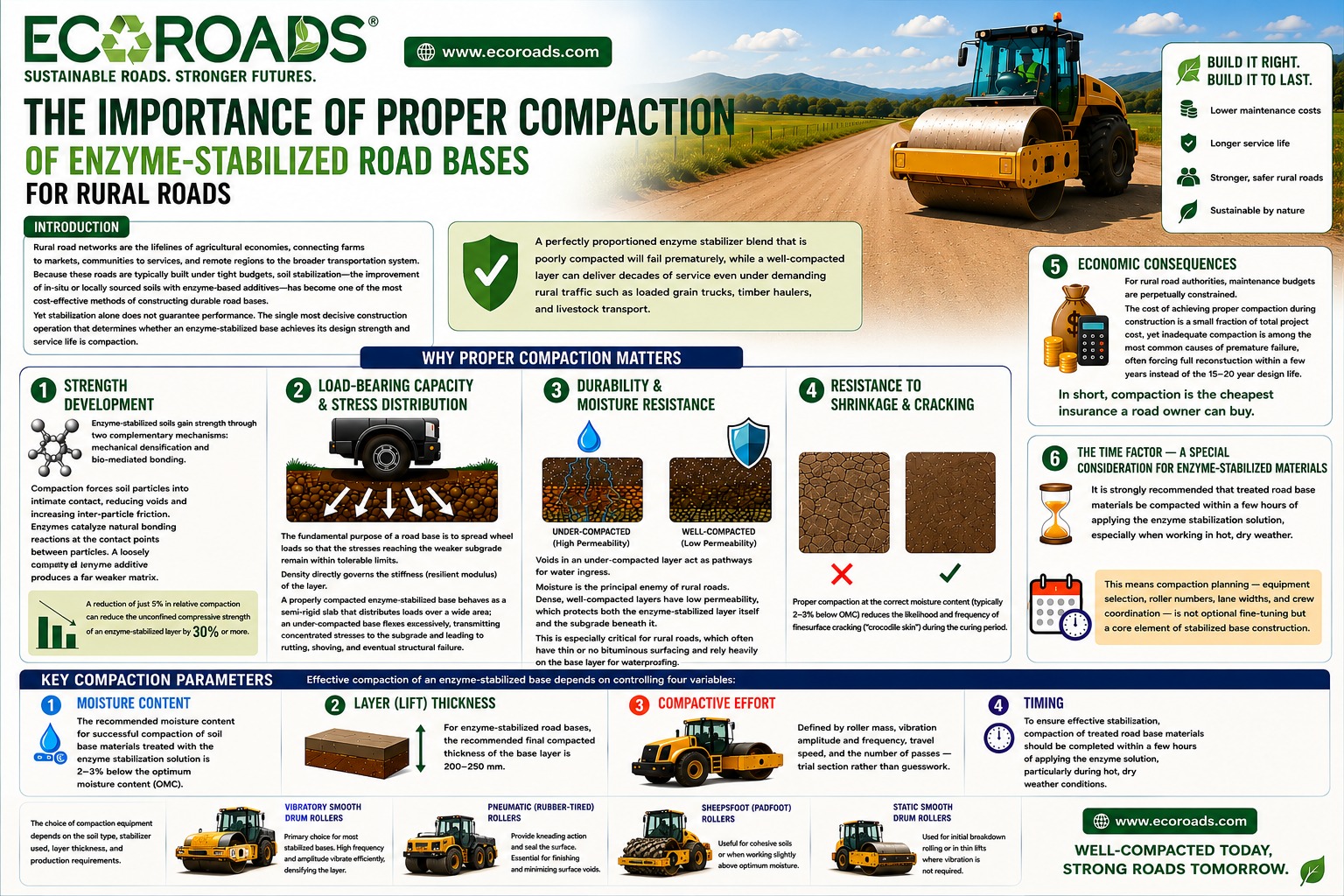
Introduction
Rural road networks are the lifelines of agricultural economies, connecting farms to markets, communities to services, and remote regions to the broader transportation system. Because these roads are typically built under tight budgets, soil stabilization — the improvement of in-situ or locally sourced soils with an additive — has become one of the most cost-effective methods of constructing durable road bases. While conventional binders such as cement, lime, and fly ash have long been used for this purpose, enzyme-based stabilization has gained rapid acceptance for rural roads because it works with the natural soil already on site rather than importing large volumes of aggregate or chemically rigid binder.
ECOROADS is a concentrated, natural based liquid enzyme stabilizer designed for exactly this application. Diluted in the compaction water and mixed into fine-grained soils, it catalysis reactions between the clay particles and soil moisture that permanently reduce the clay’s affinity for water, allowing the treated soil to be compacted into a far denser, more stable, and less permeable mass than the untreated material would ever reach. The result is a strong, water-resistant road base built largely from the soil the road is already made of.
Yet stabilization alone does not guarantee performance. Because ECOROADS works by enabling, not replacing, mechanical densification, the single most decisive construction operation that determines whether the stabilized base achieves its design strength and service life is compaction. The enzyme makes a tighter, more water-resistant packing of the clay possible; only the rollers make it real. A correctly dosed ECOROADS application that is poorly compacted will fail prematurely, while a well-compacted layer can deliver decades of service even under demanding rural traffic such as loaded grain trucks, timber haulers, and livestock transport. This article explains why proper compaction is so critical to capturing the full benefit of enzyme stabilization, and how to plan, execute, and control it.
The Benefits of ECOROADS® Enzyme Stabilization
ECOROADS offers a combination of structural, economic, and environmental advantages that make it especially well-suited to rural road construction. It is important to recognize from the outset that every one of these benefits is unlocked by — and conditional upon — achieving the specified field density. The enzyme creates the potential for a superior layer; compaction converts that potential into delivered performance.
- Uses in-situ and local soils. Fine-grained, clayey soils that would otherwise be rejected as base material can be treated in place, dramatically reducing the cost and carbon of hauling in imported gravel or crushed aggregate.
- Permanent reduction in water sensitivity. By neutralising the clay’s attraction to water, the treatment reduces swelling, shrinkage, and softening — the chief causes of rural-road failure — and produces a layer that stays stable through wet and dry seasons.
- Higher density and bearing capacity. With the adsorbed-water film broken down, the same compactive effort drives the soil to a higher dry density and a markedly higher CBR than the untreated material, yielding a stiffer, stronger base.
- Low permeability and effective waterproofing. A dense, enzyme-treated layer sheds water rather than absorbing it, protecting both the base and the subgrade beneath — critical for rural roads with thin or no bituminous surfacing.
- No brittle cementitious crust. Unlike cement- or lime-bound layers, an enzyme-stabilized base is essentially free of binder-induced shrinkage cracking; it remains a dense, tightly knit, slightly flexible platform.
- A forgiving, re-workable working window. With no hydration set to race, material that has not been finished can generally be re-moistened and re-worked, and defective areas can be scarified and re-compacted rather than demolished.
- Conventional plant, simple logistics. Standard recyclers/stabilizers, graders, water carts, and rollers do the work — no specialist equipment — while the highly concentrated liquid ships in small volumes, easing supply to remote sites.
- Environmentally benign. The enzyme is organic and non-toxic, and treating soil in place avoids the emissions of cement/lime manufacture and aggregate haulage, giving the technique a substantially lower carbon footprint.
- Faster construction and lower lifecycle cost. Low additive cost, reduced material movement, and a quick return to traffic after the layer dries back combine to lower both initial and whole-of-life costs.
Why Proper Compaction Matters
1. Strength Development
ECOROADS enzyme-based stabilized soils gain strength through two complementary mechanisms: mechanical densification and the enzyme-catalyzed modification of the clay–water system. ECOROADS accelerates cation exchange and breaks down the thick film of adsorbed water surrounding clay particles, so that under roller energy the particles slide into far closer contact than untreated soil would permit. Crucially, the enzyme does not “glue” the soil the way a cementitious binder does; it makes a higher density achievable — and the strength of the finished layer is realized only if that density is actually delivered by the rollers. A loosely compacted ECOROADS treated layer retains the voids and water-attracting behavior the treatment was meant to eliminate, so the same quantity of enzyme produces a far weaker, moisture-sensitive matrix. Field experience consistently shows that the bearing capacity and cohesion of an enzyme-treated layer rise steeply with relative compaction, and that a shortfall of just a few percent in density forfeits much of the strength gain the treatment can offer. (For comparison, even in conventional cement work a reduction of just 5% in relative compaction can cut unconfined compressive strength by 30% or more — density discipline is decisive for every stabilizer.)
2. Load-Bearing Capacity and Stress Distribution
The fundamental purpose of a road base is to spread wheel loads so that the stresses reaching the weaker subgrade remain within tolerable limits. Density directly governs the stiffness (resilient modulus) of the layer. A properly compacted enzyme-stabilized base behaves as a dense, tightly bound platform that distributes loads over a wide area; an under-compacted base flexes excessively, transmitting concentrated stresses to the subgrade and leading to rutting, shoving, and eventual structural failure.
3. Durability and Moisture Resistance
Voids in an under-compacted layer act as pathways for water ingress. Moisture is the principal enemy of rural roads: it softens the subgrade, swells untreated clay pockets, promotes freeze–thaw damage in cold climates, and erodes unbound fines. The central benefit of ECOROADS stabilization, a permanent reduction in the clay’s attraction to water, is only fully expressed in a dense matrix: low void content and the enzyme-modified clay together give the layer very low permeability and greatly reduced swell. This protects both the stabilized layer itself and the subgrade beneath it, which is especially critical for rural roads that often have thin or no bituminous surfacing and rely heavily on the base layer for waterproofing.
4. Resistance to Surface Loss and Cracking
Unlike cementitious binders, enzyme-stabilized layers are essentially free of binder-induced shrinkage cracking — one of the technique’s practical advantages. The cracking and raveling risks that do exist are moisture-driven: compacting too wet leaves excess water that must later evaporate, producing drying shrinkage and a weakly knitted surface, while compacting too dry prevents the enzyme-bearing water from being distributed through the clay fraction. Proper compaction at or near optimum moisture content minimizes both risks and produces a tight, well-knitted surface that resists raveling under direct traffic.
5. Economic Consequences
For rural road authorities, maintenance budgets are perpetually constrained. The cost of achieving proper compaction during construction is a small fraction of total project cost, yet inadequate compaction is among the most common causes of premature failure, often forcing full reconstruction within a few years instead of the 15–20 year design life. ECOROADS is attractive precisely because the additive cost is low and conventional earthmoving plant is used — but that economy is realised only when the compaction operation is taken seriously. In short, compaction is the cheapest insurance a road owner can buy.
6. The Time Factor — A Practical Advantage of Enzyme Treatment
One of the operational advantages of ECOROADS is its forgiving working window. Because there is no hydration set, the mixed material does not “go off” within a couple of hours the way a cement-treated base does, and material that has not been finished can generally be re-moistened and re-worked without permanent damage. The time pressure that does exist is moisture-driven: the enzyme is delivered in the compaction water, so the layer must be compacted while the moisture content is still near optimum. In hot, windy rural conditions, evaporation can pull the surface below the workable range within hours, forcing re-watering and re-mixing that wastes time and risks uneven enzyme distribution. Compaction planning — equipment selection, roller numbers, lane widths, water-cart cycles, and crew coordination — therefore remains a core element of enzyme-stabilized base construction, not optional fine-tuning.
Key Compaction Parameters
Effective compaction of an stabilized base depends on controlling four variables:
- Moisture content. Every soil–enzyme mixture has an optimum moisture content (OMC) at which a given compactive effort produces maximum dry density (MDD). Field moisture should normally be held within ±1–2% of OMC — and because the diluted enzyme is applied in the compaction water, moisture control is simultaneously dosage control. Hot, windy rural conditions cause rapid evaporation and must be compensated by the water cart.
- Layer (lift) thickness. Compacted lifts are typically limited to 150–200 mm (up to 250–300 mm with heavy vibratory equipment and verification trials), because compactive energy decays with depth and a thick lift will show a dense crust over a weak bottom.
- Compactive effort. Defined by roller mass, vibration amplitude and frequency, travel speed, and the number of passes — best established through a field trial section rather than guesswork.
- Timing. All compaction should be completed while the layer is within the specified moisture band, and the finished surface should then be shaped tight and allowed to air-cure (dry back) before being opened to traffic.
Types of Compactors Suitable for Stabilized Road Bases
The choice of compaction equipment depends on the soil type, layer thickness, and project scale. Because enzyme stabilization is most effective in fine-grained soils with an appreciable clay fraction, kneading-type compactors play an especially prominent role. On rural projects, a combination of machines is usually employed in a compaction “train.”
1. Vibratory Smooth Drum Rollers
The workhorse of stabilized base compaction. Single-drum vibratory rollers in the 12–20 tone class combine static weight with dynamic vibratory energy, rearranging particles and achieving high densities through the full lift, particularly in sandy and gravelly soils whose fines fraction carries the enzyme treatment. Modern machines allow variable amplitude and frequency: high amplitude/low frequency for initial deep compaction of thicker lifts, low amplitude/high frequency for finishing. Operating speed should generally be kept between 3 and 6 km/h. Because enzyme-treated material has no chemical set, vibratory passes can be sequenced flexibly across the shift — the governing constraint is keeping the layer within the moisture band, not racing a binder’s setting time.
2. Padfoot (Tamping-Foot) and Sheepsfoot Rollers
Essential for fine-grained, cohesive soils — exactly the clays and silty clays for which enzyme stabilization is best suited on rural roads. The projecting pads penetrate the loose lift and compact it from the bottom up, kneading the soil, breaking down clods, and working the enzyme-bearing water uniformly through the clay fraction — the kneading action itself improves contact between the enzyme solution and the clay particles it must modify. The roller “walks out” of the layer as density increases, which is a useful visual indicator of progress. Vibratory padfoot rollers combine kneading with dynamic energy and are highly productive on enzyme-treated clays. Because padfoot rollers leave an indented surface, they are always followed by a smooth drum or pneumatic roller to seal and finish the layer.
3. Pneumatic-Tyre Rollers (PTR)
Multi-wheel rubber-tyre rollers (typically 10–25 tones) apply a kneading action that manipulates the material, closes surface voids, and produces a tight, sealed finish. They are particularly valuable as finishing rollers on enzyme-treated bases, where the kneading action knits the fines into a dense, water-shedding skin, and for proof-rolling. Tyre pressure can be adjusted to suit the material, higher pressures for greater depth of influence, lower pressures for surface sealing. On rural roads the PTR’s sealing action is doubly important because the enzyme-stabilized base may carry traffic directly or receive only a thin chip seal.
4. Static Three-Wheel and Tandem Steel Rollers
Traditional static steel rollers (8–12 tons) are less efficient at deep densification than vibratory machines, but remain useful for final finishing passes, removing roller marks, tightening the surface after the layer has begun to dry back, and compacting near structures where vibration is undesirable.
5. Grid Rollers
Towed grid rollers are occasionally used in rural settings on coarse, gravelly, or soft-rock materials, where the grid breaks down oversize particles while compacting. Their role in enzyme-stabilized work is mainly in pre-processing marginal materials, reducing oversize and generating fines, before the enzyme treatment is applied.
6. Impact (High-Energy) Rollers
Non-circular (3-, 4-, or 5-sided) towed impact rollers deliver very high energy per blow and can compact thick lifts or improve subgrades in deep layers. They are more common in subgrade improvement than in finished stabilized base work, but on large rural programs they can reduce the number of lifts required.
7. Small Equipment for Confined Areas
Rural projects inevitably include culvert crossings, bridge approaches, widenings, and utility trenches where large rollers cannot operate. Walk-behind vibratory rollers, trench rollers, plate compactors, and rammers (jumping jacks) must be used, with lift thicknesses reduced (often to 100–150 mm) to compensate for their lower energy. These confined areas are notorious weak points and deserve extra testing attention.
Typical Compaction Train for a Rural Enzyme-Stabilized Base
A common and effective sequence is: padfoot vibratory roller for initial breakdown compaction and kneading of the cohesive, enzyme-treated soil → heavy smooth drum vibratory roller for primary densification → pneumatic-tyred roller for kneading and sealing → static smooth drum for final finish, with a grader trimming the surface between intermediate and final rolling.
Compaction Control: What Must Be Implemented
Compaction quality cannot be left to visual judgment. A structured quality control / quality assurance (QC/QA) system must be implemented, comprising laboratory reference testing, a field trial, in-process control, and acceptance testing.
1. Laboratory Reference Testing (Before Construction)
The control program begins in the laboratory. For each soil–enzyme combination, a moisture–density relationship must be established using the Proctor compaction test — standard Proctor (AASHTO T 99 / ASTM D698) or, more commonly for road bases, modified Proctor (AASHTO T 180 / ASTM D1557) — with ECOROADS® included in the compaction water at the design dilution. This defines the maximum dry density (MDD) and optimum moisture content (OMC) that become the reference for all field control. Equally important is confirming that the soil is suitable for enzyme treatment at all: Atterberg limits and gradation should verify an adequate clay/fines content and plasticity (enzymes are ineffective in clean, non-plastic sands and gravels), and organic content should be checked where peaty or topsoil contamination is suspected. Supporting strength tests — California Bearing Ratio (CBR) and/or unconfined compressive strength (UCS) on treated versus untreated specimens — should be carried out at the design application rate, with treated specimens cured (air-dried) for the period specified in the ECOROADS® technical documentation before testing, because enzyme-treated soils gain strength gradually as they dry and consolidate rather than through a rapid chemical set.
2. Field Trial Section
Before full production, a trial section (typically 100–200 m) recommended to be constructed using the proposed equipment, lift thickness, moisture targets, and enzyme dilution. Density is measured after successive roller passes to develop a compaction growth curve, establishing the rolling pattern (machine type, amplitude, speed, number of passes) that reliably achieves the specified density while the layer remains within the moisture band. The approved pattern then becomes a method-control element of the specification — invaluable on rural projects where testing resources are limited.
3. In-Process (Method and Moisture) Control
During production, continuous checks must include: the enzyme application rate (verifying the volume of ECOROADS concentrate metered into each water-cart load against the design rate — typically expressed as liters of concentrate per cubic meter of compacted soil, and logging every load); dilution and distribution uniformity (consistent spray-bar output and overlapping watering passes); mixing depth and uniformity (test holes behind the recycler or grader to confirm full-depth, streak-free blending); field moisture content immediately before compaction (oven drying, speedy moisture tester, or calibrated moisture probes); and lift thickness (depth checks behind the recycler/grader). Ambient conditions (temperature, wind, rain risk) should be logged because they govern evaporation and the time available to complete compaction within the moisture band.
4. Field Density (Acceptance) Testing
The core acceptance criterion is relative compaction — field dry density expressed as a percentage of laboratory MDD. Typical specifications for enzyme-stabilized rural road bases require 95–98% of modified Proctor MDD (or 98–100% of standard Proctor, depending on the governing standard), with moisture within the specified band. The principal test methods are:
- Nuclear density gauge (ASTM D6938 / AASHTO T 310): the fastest and most widely used method, giving wet density and moisture in 1–4 minutes per test. It allows high testing frequency and immediate corrective action. Gauges must be calibrated against the project material (moisture readings in particular should be verified against oven drying on clayey soils) and operated under radiation-safety licensing.
- Sand cone test (ASTM D1556) and rubber balloon test (ASTM D2167): classical direct-measurement methods, slower but independent of calibration assumptions, often used to verify nuclear gauge results or where gauges are unavailable — a common situation on remote rural projects.
- Non-nuclear electrical gauges (e.g., ASTM D7830): increasingly used to avoid radiological licensing, but they require careful material-specific calibration, particularly on treated clayey soils.
Testing frequency should be specified — commonly one density test per 250–500 m² of layer, or per 100–200 linear meters per lane, with additional tests at culverts, approaches, joints between work sections, and any area of doubt. A statistical acceptance scheme (lot-based, with minimum individual and mean values) gives better protection than isolated spot tests.
5. Strength and Stiffness Verification
Density alone does not prove the enzyme treatment is working; complementary controls should include: CBR or UCS testing of field-mixed material compacted into moulds on site and cured (air-dried) for the specified period, checked against the design strength; the Dynamic Cone Penetrometer (DCP, ASTM D6951), an inexpensive, robust tool ideally suited to rural projects for verifying uniformity with depth and detecting weak lower zones in the lift — and, repeated after the curing period, for confirming the strength gain of the enzyme-treated layer as it dries; and the Light Weight Deflectometer (LWD, ASTM E2583) or Falling Weight Deflectometer for modulus-based verification where deflection-based specifications are used.
6. Proof Rolling
Before surfacing, the completed base should be proof-rolled with a loaded truck (e.g., 8-tonne axle) or heavy pneumatic roller under observation. Any visible deflection, pumping, or rutting identifies soft spots that density tests on a grid may have missed. Defective areas must be reworked — and here enzyme stabilization holds a clear practical advantage: unlike a cemented layer past its setting time, a defective enzyme-treated area can usually be scarified, re-moistened (with enzyme-dosed water if additional mixing is needed), and re-compacted rather than removed and replaced.
7. Intelligent Compaction (IC) and Continuous Compaction Control (CCC)
Modern rollers can be fitted with drum-mounted accelerometers, GPS mapping, and onboard displays that record stiffness-related values (CMV, MDP, Evib) over 100% of the layer, rather than the <1% coverage of spot testing. For rural agencies managing long, linear projects with few technicians, IC offers full-coverage documentation of pass counts and uniformity, flagging weak areas for targeted spot testing. IC values must always be correlated to conventional density/modulus tests on a calibration strip, but as a process-control tool it dramatically improves uniformity — and uniformity is itself a major determinant of pavement life.
8. Curing Control
Compaction control does not end when the roller leaves. Enzyme-stabilized layers cure by drying back and consolidating: the finished surface should be shaped tight, drained, and protected from heavy traffic and rain for typically 24–72 hours (longer in cool or humid weather), allowing the layer to dry toward its stable in-service moisture content. Unlike cementitious layers, no moist curing or curing membrane is required — drying is precisely what develops the strength — but premature trafficking of a still-wet layer, or saturation by rain before the surface has tightened, will damage the work. Records of curing duration, weather, and the date the layer was opened to traffic or sealed form part of the quality file.
9. Documentation
Every lot should be traceable through records of: ECOROADS® batch numbers, dilution rates and water-cart loads, mixing depth, moisture tests, rolling pattern and pass counts, density and strength test results, proof-rolling observations, and curing. On rural programs delivered by small contractors, a simple standardized lot sheet enforces discipline and provides the evidence base for acceptance and future maintenance planning.
Common Compaction Defects and Their Causes
Several recurring problems deserve mention. Low density at the bottom of the lift usually indicates an excessive lift thickness or insufficient roller energy, and is best detected with the DCP. A loose, dusty, or ravelling surface results from compacting after the surface has dried below the workable moisture range, or from finishing without adequate kneading by a pneumatic roller; the remedy is light moisture fogging (with plain water) and re-rolling before the layer dries out. Laminations occur when a thin re-trimmed layer is compacted over an already dried-back surface without scarifying and re-moistening it to achieve bond. Soft, rutting areas after opening to traffic typically indicate compaction at excessive moisture, an under-dosed or poorly mixed enzyme application, or trafficking before the layer had dried back and gained strength. Each of these defects is preventable through the control regime described above.
Conclusion
For rural roads, where stabilized bases often serve as the principal, sometimes the only, structural and waterproofing layer, proper compaction is not a routine construction detail but the decisive factor between a road that lasts two decades and one that fails in two years. This is doubly true for ECOROADS enzyme stabilization, whose entire mechanism depends on densification: the enzyme makes a tighter, more water-resistant packing of the clay possible, and only the rollers make it real. The structural, economic, and environmental benefits of treating soil in place — higher density and bearing capacity, low permeability, freedom from shrinkage cracking, a forgiving working window, and low cost and low carbon footprint, are all delivered through, and conditional upon, the density achieved in the field.
Capturing those benefits requires three things working together: a clear understanding of why density matters for strength, stiffness, durability, and moisture resistance; the right combination of compaction equipment — padfoot rollers for kneading the cohesive, enzyme-treated soil, heavy vibratory smooth drums for primary densification, and pneumatic-tyre rollers for kneading and sealing — operated within the layer’s workable moisture band; and a rigorous but practical control system built on Proctor reference values established with ECOROADS-dosed water, soil suitability and dosage verification, trial sections, field density testing (nuclear gauge, sand cone, or non-nuclear methods), DCP and CBR/UCS verification before and after curing, proof rolling, dry-back curing control, and complete documentation. Agencies and contractors that institutionalize these practices convert the inherent economy of ECOROADS enzyme soil stabilization into genuinely long-lived rural infrastructure, protecting scarce maintenance budgets and the communities that depend on these roads.
Note: Specification values cited (relative compaction targets, lift thicknesses, curing periods, testing frequencies) are typical international practice. ECOROADS dilution rates, soil suitability criteria, application rates, and curing requirements should always be confirmed against the ECOROADS technical documentation, together with the governing national or agency standard for your project or local rural road specifications.
Find Out More about ECOROADS soil stabilization.
ECOROADS specialises in enzyme-based soil stabilization solutions proven across diverse soil types and climate conditions. ECOROADS product offer a cost-effective, environmentally responsible alternative to conventional cement and lime stabilization.
👉 Explore ECOROADS solutions at www.ecoroads.com
Our articles are also featured on EcoEnviroNews